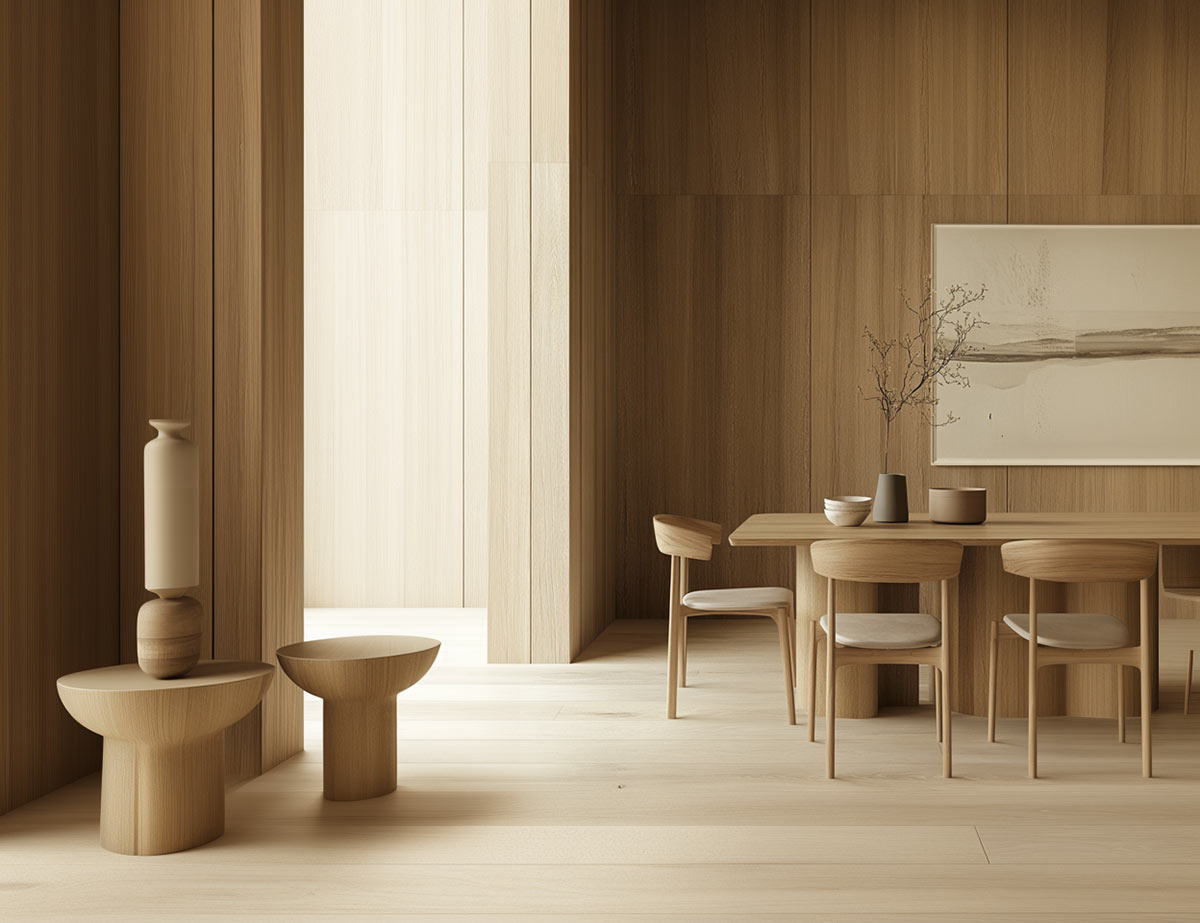
How to Choose Between Ten Oak Colours for a Project
Oak by Woodez | For designers, architects and builders
Choosing a floor colour looks simple on a sample board and gets complicated on site. The same oak can read warm in the morning, flat at midday and yellow under evening lighting. Ten colours across the range makes the decision harder, not easier, unless you narrow it with a method.
This guide sets out a practical process for getting from ten options to one, and the common mistakes to avoid on the way.
The Oak by Woodez colour range
The sample range includes ten colours:
- Caspian- Light tone
- Ember- Dark tone
- Graphite - Dark tone
- Paperbark - Mid tone
- Dove Grey - Mid tone
- Aspen - Light tone
- Albino - Light tone
- Sol - Mid tone
- Smokey Stout - Dark tone
- Roasted Acorn - Dark tone
Rather than choosing by name or by a single photo, work through the steps below.
Step 1: Start with what is already fixed
A floor is never chosen alone. Before looking at any sample, list the finishes that are already decided or hard to change:
- Stone and benchtops
- Joinery and cabinetry
- Wall and ceiling colours
- Tapware, hardware and lighting
- Existing materials being kept
The floor should be selected against these, not in isolation.
Step 2: Decide the undertone
Undertone is the single most common source of a floor that feels slightly wrong. Oak tends to carry a warm, neutral or cool cast, and it needs to sit comfortably with the undertones of the fixed finishes.
A warm stone next to a cool-toned floor, or a cool grey wall against a yellow-leaning oak, will look off even when each material is beautiful on its own. Place samples directly against your fixed finishes and see whether the undertones agree or fight.
Step 3: Decide the depth
Depth is how light or dark the floor sits. It changes how a space feels:
- Lighter floors tend to make a room feel larger and brighter, and suit spaces with limited natural light.
- Mid-tones are often the most forgiving, and they sit easily with a wide range of joinery and wall colours.
- Darker floors add weight and contrast, and work well in rooms with plenty of light.
Also consider contrast. A floor close in tone to the joinery and walls creates a calm, tonal space. A floor in strong contrast gives definition and drama.
Step 4: Test in the real light
Colour changes with light, so test samples in the room where the floor will go.
- Check at different times of day: morning, midday and evening.
- Check under the artificial lighting that will be installed. Warm and cool lamps shift how oak reads.
- Consider orientation. A room with strong direct sun behaves differently to a shaded one.
- Place the sample on the floor, not on a wall. Light falls on a floor from above, and the colour reads differently flat than upright.
Step 5: Account for finish and texture
Oak by Woodez boards are wire brushed and finished with WOCA UV hardwax oil. The brushed texture and matte finish affect how colour reads. They add depth and variation to the surface, and they soften the look compared with a smooth, glossy board. Judge the colour on the actual sample, not on a photograph.
Step 6: Plan for natural variation
Oak is a natural material. Grain, texture, knots and colour vary from board to board, and a sample is a guide to what to expect, not a guarantee of every plank.
- View a larger sample, or several boards, not a single small piece.
- Brief clients that variation is part of the character of real oak.
- Order the full quantity from one batch so the colour is consistent across the floor.
Step 7: Narrow to two or three, then decide
Once you have worked through the steps, shortlist two or three colours and request samples for each. Put them in the room together, next to the fixed finishes, and look at them over a few days. Show the client the samples in place, not in a showroom, and make the final choice there.
Common mistakes
- Choosing from a photograph or a screen
- Judging a sample in the showroom and never in the room
- Ignoring undertone until the floor is installed
- Testing samples on a wall or table, not on the floor
- Expecting every board to match the sample exactly
- Leaving the decision until after the order quantity is locked
A quick checklist
- Fixed finishes listed and sampled alongside
- Undertone and depth decided
- Samples checked at several times of day and under installed lighting
- Shortlist of two or three, viewed together on the floor
- Client has seen natural variation
- Full quantity ordered from one batch
Specifying Oak by Woodez
Request a designer sample box to see the boards in your own light, or visit the showroom at 209 Albion Street, Surry Hills. Spec sheets, installation guides and care guides are available for every colour.
Heading 1
Heading 2
Heading 3
Heading 4
Heading 5
Heading 6
Lorem ipsum dolor sit amet, consectetur adipiscing elit, sed do eiusmod tempor incididunt ut labore et dolore magna aliqua. Ut enim ad minim veniam, quis nostrud exercitation ullamco laboris nisi ut aliquip ex ea commodo consequat. Duis aute irure dolor in reprehenderit in voluptate velit esse cillum dolore eu fugiat nulla pariatur.
Block quote
Ordered list
- Item 1
- Item 2
- Item 3
Unordered list
- Item A
- Item B
- Item C
Bold text
Emphasis
Superscript
Subscript

.png)