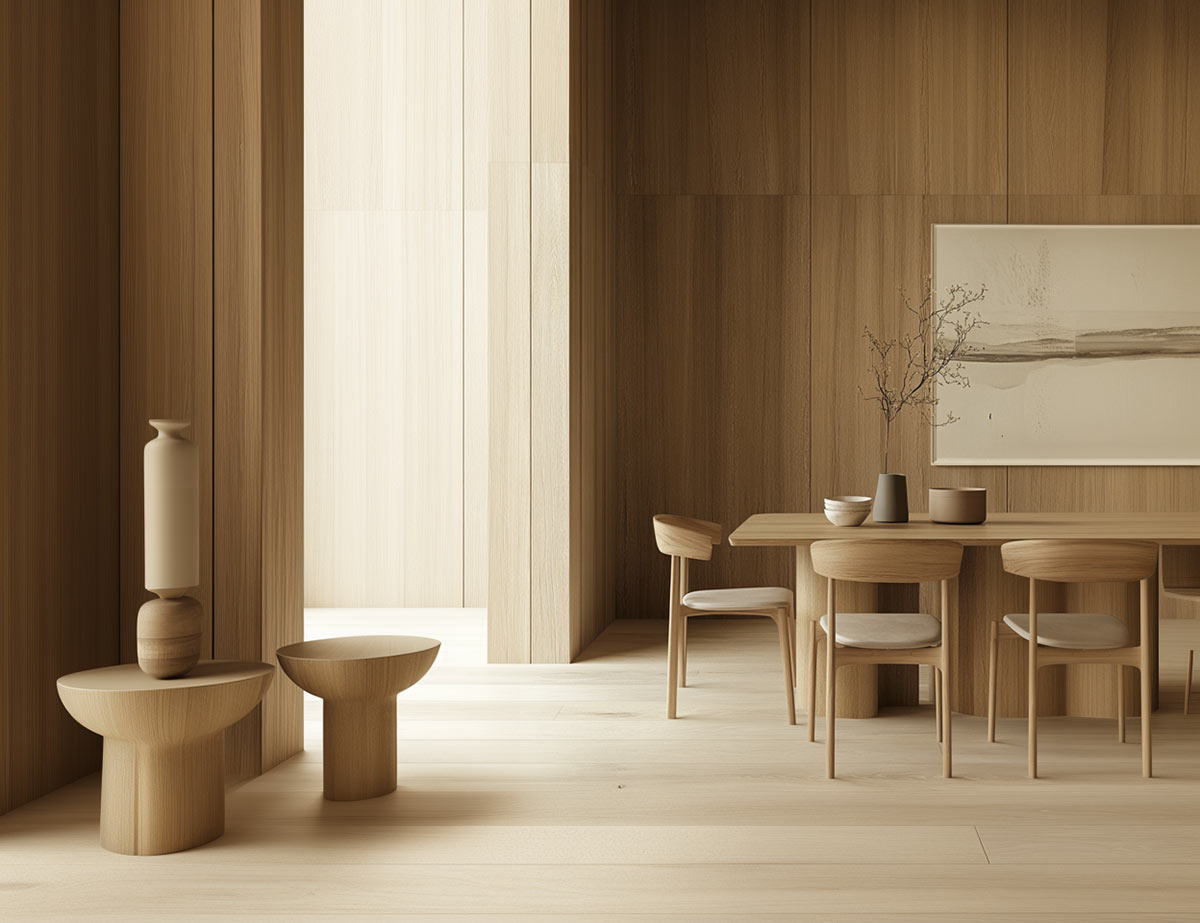
Oak Flooring for Heritage Terrace Renovations
Oak by Woodez | For designers, architects and builders
A heritage terrace renovation asks a floor to do two things at once. It has to respect a house that is more than a century old, and it has to suit the way the family lives now. Oak does both well, but only if the floor is planned around the building, not just chosen from a sample board.
This guide covers what is different about terrace projects, what to check in the existing floor, how to handle the join between old and new, and how to choose a format and tone that sit comfortably in a period home.
What makes a terrace different
Terraces share a set of constraints that a standard renovation does not have:
- Long, narrow plans. A single run of flooring often passes through the hall, living areas and kitchen, so the floor reads as one continuous surface.
- Old structure under the floor. Original floors are usually timber boards on joists over a ventilated subfloor space, and they have moved over a century.
- Old and new in one house. The original front section is often joined to a rear extension built on a concrete slab, with a different floor height and construction.
- Tight sites. Narrow streets, shared walls and small footprints affect deliveries, storage and trades.
- Heritage controls. Depending on the property, there may be requirements to check before work starts.
Start with the existing floor
Before choosing a product, find out what you are building on. A good assessment covers:
- Condition of the existing boards and joists. Decide whether the floor is being restored or replaced, and whether the structure is sound.
- Subfloor ventilation and moisture. Damp or poorly ventilated subfloor spaces are common in older homes and need to be resolved before a new floor goes down. Test moisture levels and confirm they are within the limits in the installation guide.
- Flatness and level. Old floors are rarely flat. Pattern and wide-plank formats show unevenness, so the subfloor needs to be prepared to the flatness tolerance in the guide.
- Fixing method. The right method depends on what is underneath. Oak by Woodez boards can be direct stick, glued and secret nailed, or floated. Confirm the approved method for your substrate and format in the installation guide.
Where old meets new
The hardest detail in many terrace projects is the join between the original house and the rear addition, where timber framing meets a concrete slab. The two often sit at different heights and behave differently.
The design goal is usually a floor that runs through without a visible break. Plan this early:
- Resolve the finished floor levels across both sections before the slab is poured or the subfloor is prepared.
- Use the substrate preparation and fixing method suited to each section, so the same board can run continuously across both.
- If a break is unavoidable, detail it deliberately, with a threshold or joint that looks intended.
This is also where core construction matters. A Birch multiply base, with its cross-laminated plies, is built to resist the movement that can open gaps and cup boards over time. See our guide to Birch multiply versus standard engineered flooring for how that works.
Choosing format and tone
Width. Original terrace floors are typically narrower boards. A wider plank reads more contemporary, while a narrower board sits closer to the original character. Oak by Woodez planks are available at 190 x 15mm.
Pattern. Herringbone is a classic period nod, particularly in a hallway, entry or main living space. It is also the most demanding format to lay, so plan the set-out carefully. See our guide to herringbone and chevron layout, waste and installation.
Colour and light. Terraces are often dark in the middle of the plan, with light only at the front and rear. Colour choice should be tested against the actual light in the house, using a physical sample in each room.
Finish. Oak by Woodez boards are wire brushed and finished with WOCA UV hardwax oil. The texture gives a natural, matte look that suits older homes, and hardwax oil finishes are generally easier to maintain and spot repair than a film finish. Follow the care guide for the right products and routine.
Heritage approvals and constraints
Whether heritage controls affect the interior depends on the property, its listing and the local council. Requirements are often focused on the exterior and streetscape, but some properties have interior provisions. Check with the council or a heritage consultant before settling the design, and confirm any rules about retaining or altering original floors.
Practical details to settle early
- Floor build-up. Allow for the finished floor thickness, any underlay and the effect on door clearances, thresholds and skirting heights.
- Perimeter gaps. Plan expansion gaps and how skirtings will cover them, especially against old, uneven walls.
- Storage and acclimatisation. Boards need to adjust to site conditions before installation. In a small terrace, work out where they will be stored.
- Delivery and access. Narrow streets and long halls affect how boards arrive and move through the house.
- Neighbours and sound. In attached homes, think about footfall noise and choose an appropriate underlay.
In practice: the Petersham project
Our Petersham project used Oak by Woodez in Caspian in a renovation that balanced the home's heritage charm with modern living. Oak in the flooring and cabinetry, paired with stone accents, gave the spaces a cohesive, calm feel, with materials chosen for durability as much as appearance. ( Project designed and built by TASS CONSTRUCTION GROUP)
.png)
Specifying Oak by Woodez
Spec sheets, installation guides and care guides are available for every colour in the range. To see the boards in person, request a designer sample box or visit the showroom at 209 Albion Street, Surry Hills.
Heading 1
Heading 2
Heading 3
Heading 4
Heading 5
Heading 6
Lorem ipsum dolor sit amet, consectetur adipiscing elit, sed do eiusmod tempor incididunt ut labore et dolore magna aliqua. Ut enim ad minim veniam, quis nostrud exercitation ullamco laboris nisi ut aliquip ex ea commodo consequat. Duis aute irure dolor in reprehenderit in voluptate velit esse cillum dolore eu fugiat nulla pariatur.
Block quote
Ordered list
- Item 1
- Item 2
- Item 3
Unordered list
- Item A
- Item B
- Item C
Bold text
Emphasis
Superscript
Subscript